Fagprojekt (course 02466, Project Work), a smaller project course that precedes the bachelor thesis, in the BSc Artificial Intelligence and Data at DTU, Spring 2025, with Benjamin Banks and Jonathan Tybirk.
The problem
A LiDAR scanner sees an object only from the outside, and only from some angles: you get a sparse, noisy point cloud, not the full surface. We asked: from such a point cloud alone, can a network recover the centroid of the underlying mesh? The centroid is a physically meaningful quantity: it moves and rotates exactly with the object. That makes the task a natural test case for SE(3)-equivariant networks, architectures that are mathematically guaranteed to respect 3D rotation and translation symmetry, instead of having to learn it from data.
Method
We built a strictly rotation- and translation-equivariant message-passing graph neural network (EGNN) using spherical-harmonic features and Clebsch–Gordan tensor products, following the framework of Brandstetter et al. We compared it against size-matched non-equivariant baselines: a plain GNN, and the same GNN trained with random-rotation data augmentation. All models were trained on point clouds sampled from 11,590 ShapeNet objects (800 train / 200 validation / 10,590 test) via a simulated LiDAR process.
Results
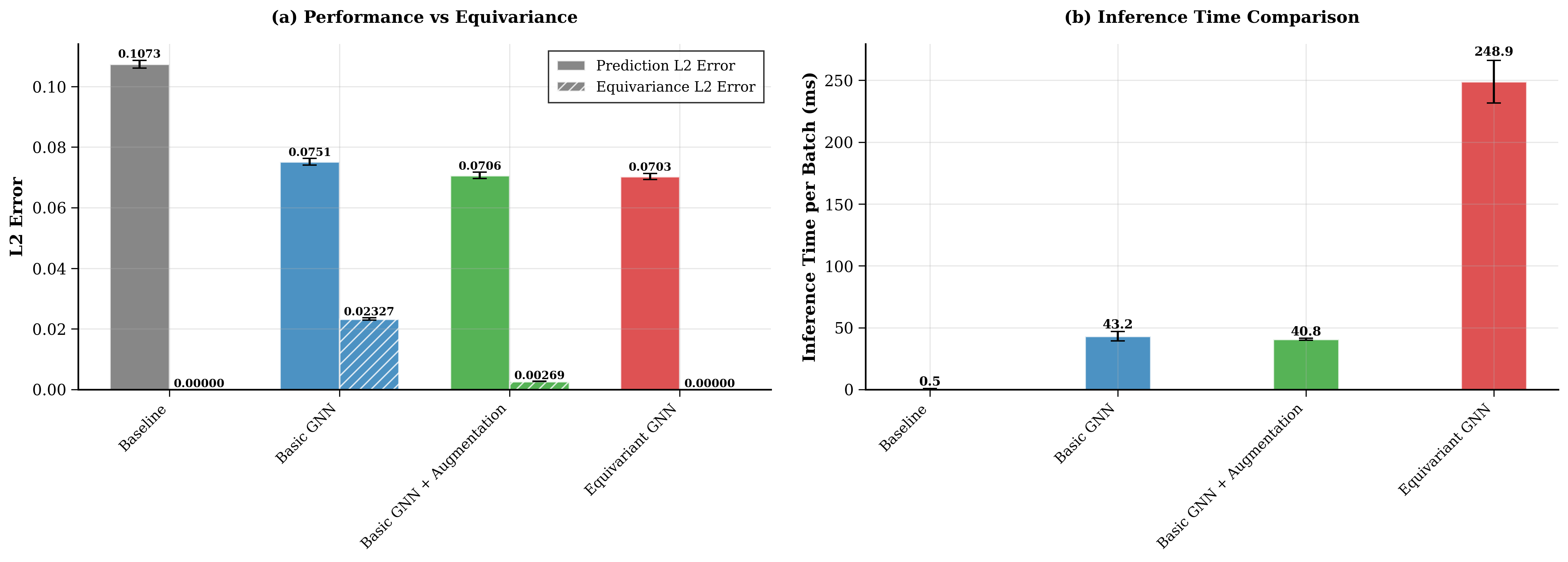
- The equivariant GNN achieved the best prediction error (0.0703 L2) while being exactly equivariant by construction (zero equivariance error).
- The augmented baseline came very close (0.0706) but retained a small residual equivariance error (0.0027); it only approximates the symmetry.
- The price of exact symmetry: the EGNN was about 6× slower at inference (≈249 ms vs ≈41 ms per batch) due to the sparse Clebsch–Gordan tensor contractions.
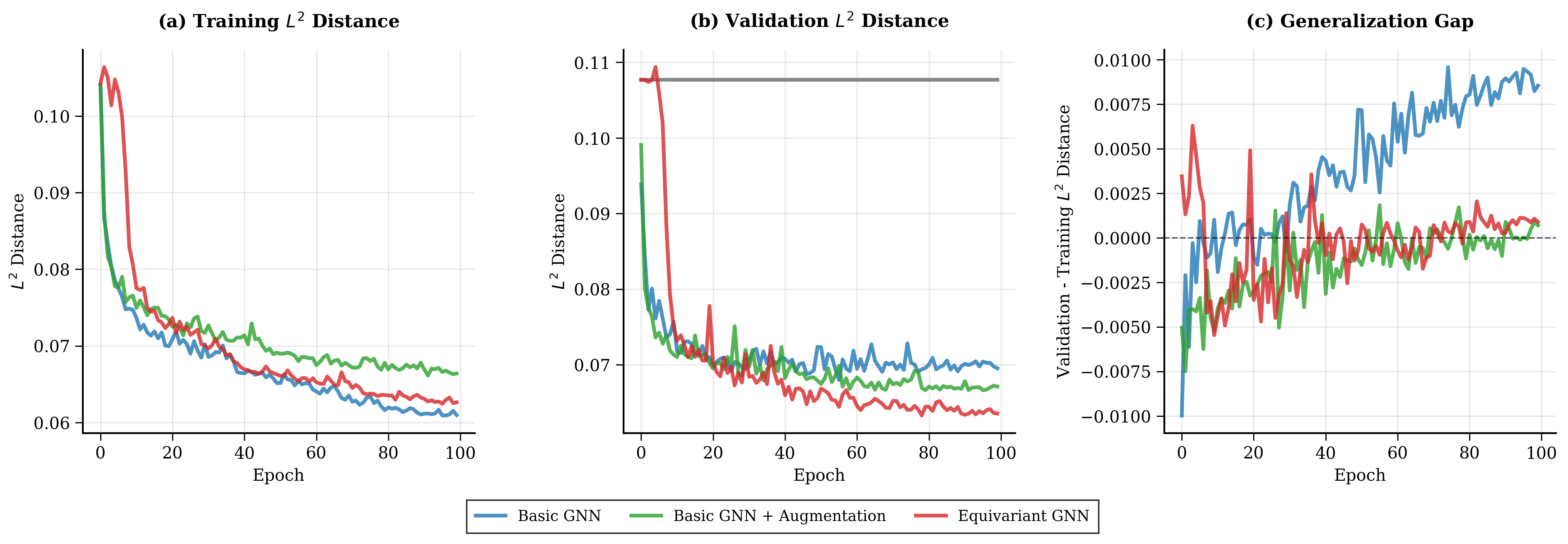
The training dynamics tell the more interesting story: the plain GNN’s generalization gap grows steadily over training, while both the equivariant model and the augmented model keep it near zero, but the equivariant model gets there by architecture rather than by data.
Takeaway: when plenty of augmented data is available, architectural equivariance is not strictly required for accuracy, but it buys exact symmetry, more stable training, and data-efficiency that matter in low-data or safety-critical settings.