Project in Statistical Evaluation (course 02445), in the BSc Artificial Intelligence and Data at DTU, Spring 2024, with Benjamin Banks, Christoffer Grauballe and Jonathan Tybirk.
The question
People increasingly ask LLMs for advice, including on personal conflicts, treating them as neutral third parties. But do they stay neutral? We asked whether the sentiment a user expresses and the perspective they write from change how GPT-4o morally judges the same story: does the model just tell you what you want to hear?
Method
We took 99 interpersonal conflicts from Reddit’s r/AmItheAsshole and asked GPT-4o to score the narrator’s moral standing from 1 to 10. For each post we varied two factors: perspective (the event framed as the user’s own vs a third party’s) and sentiment (the prompt leaning positive, neutral, or negative about the actions). That gives six framings per post, 594 prompts in total, each run in a clean session at temperature 0.
Because the scores were ordinal and far from normal, we used an Aligned Ranks Transformation two-way repeated-measures ANOVA (ART ANOVA) for the main effects, with Bonferroni-corrected pairwise t-tests for the follow-ups.
Results
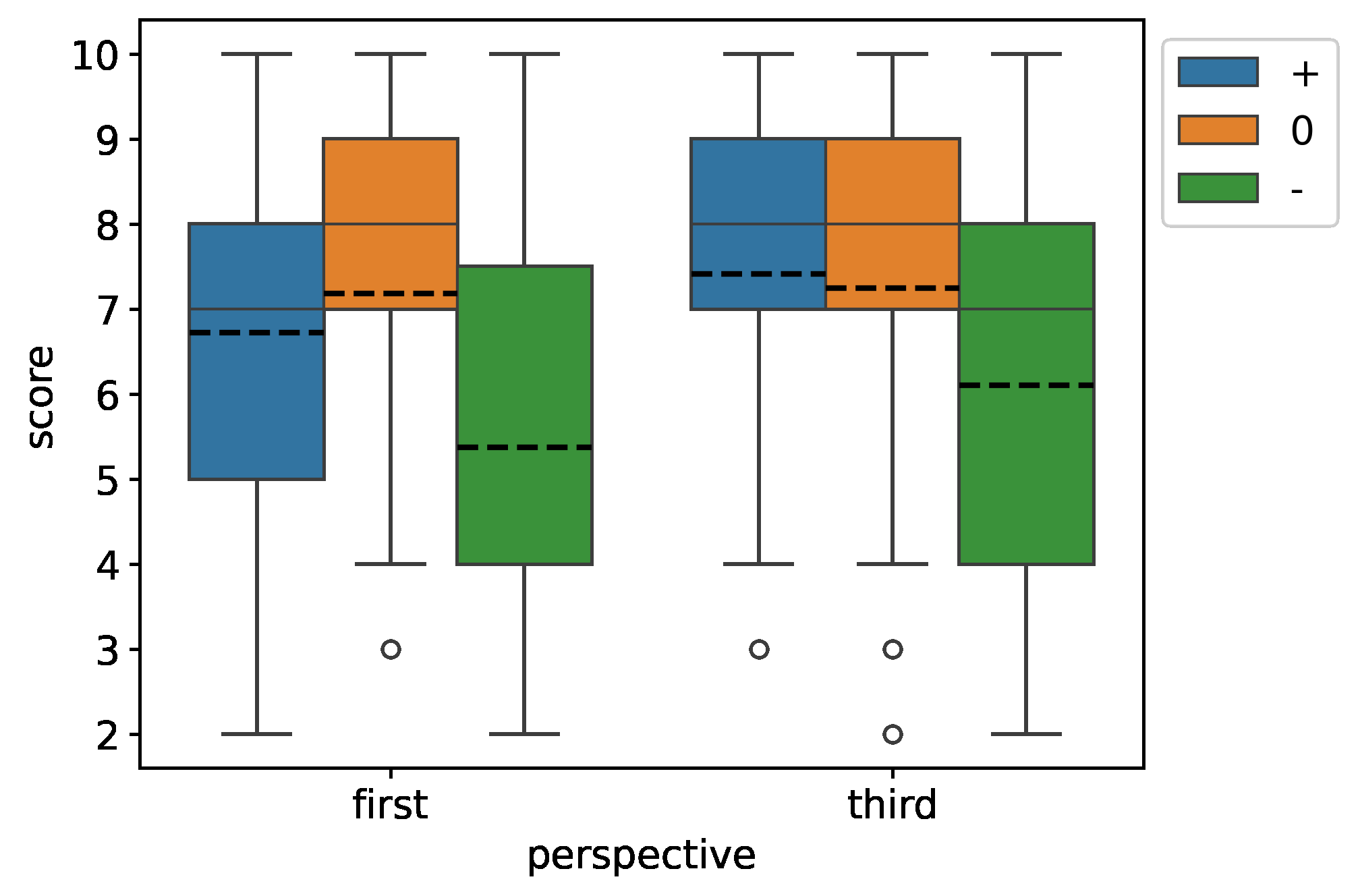
- Sentiment matters a lot (p < 2.2e-16). Negative-sentiment prompts produced significantly lower morality scores, even though the sentiment adds no new facts about what happened. The model shifts its verdict with the framing.
- Perspective matters (p ≈ 1.9e-11), but mainly through an interaction with sentiment: only when a prompt carried sentiment did first-person framing get judged more harshly than third-person. With neutral prompts, perspective barely moved the score.
- Curiously, we found a mild reverse-sycophant effect: expressing confidence that you were in the right did not buy a higher score. One reading is that the model discounts a self-narrator who shows an explicit bias.
Takeaway: GPT-4o’s moral judgment can be swayed by how a prompt is framed, especially negative sentiment, which is worth keeping in mind whenever an LLM is used as a judge in sensitive contexts. We are careful not to over-generalize from one dataset and one model.