Individual assignment for Project in Statistical Evaluation (course 02445), in the BSc Artificial Intelligence and Data at DTU, Spring 2024.
The question
In an experiment, participants solved timed puzzles in pairs while their heart rate was recorded, and rated their own frustration afterwards. Can you predict that self-reported frustration from the heart-rate signal alone? I tested this on the EmoPairCompete dataset (Das et al., 2024), using six summary statistics of each 5-minute heart-rate window (mean, median, std, min, max, area under curve) to predict a frustration score from 0 to 10.
Method
I compared five models against a mean baseline: a neural network, random forest, k-nearest neighbours, ridge regression, and (unusually for a regression target) logistic regression. Performance was measured by MSE under 8-fold cross-validation with group-aware splitting: because the same people, cohorts, and puzzle rounds recur through the data, folds never share an individual, cohort, or round between train and test, so the estimate reflects predicting a new person’s experiment rather than memorising this one.
For the statistics I used a Friedman test to check whether the models differed, followed by Bonferroni-corrected post-hoc comparisons (a normal paired t-test and the variability-aware “Setup II” from the course), with the significance level adjusted to 0.0016 across 31 tests.
Results
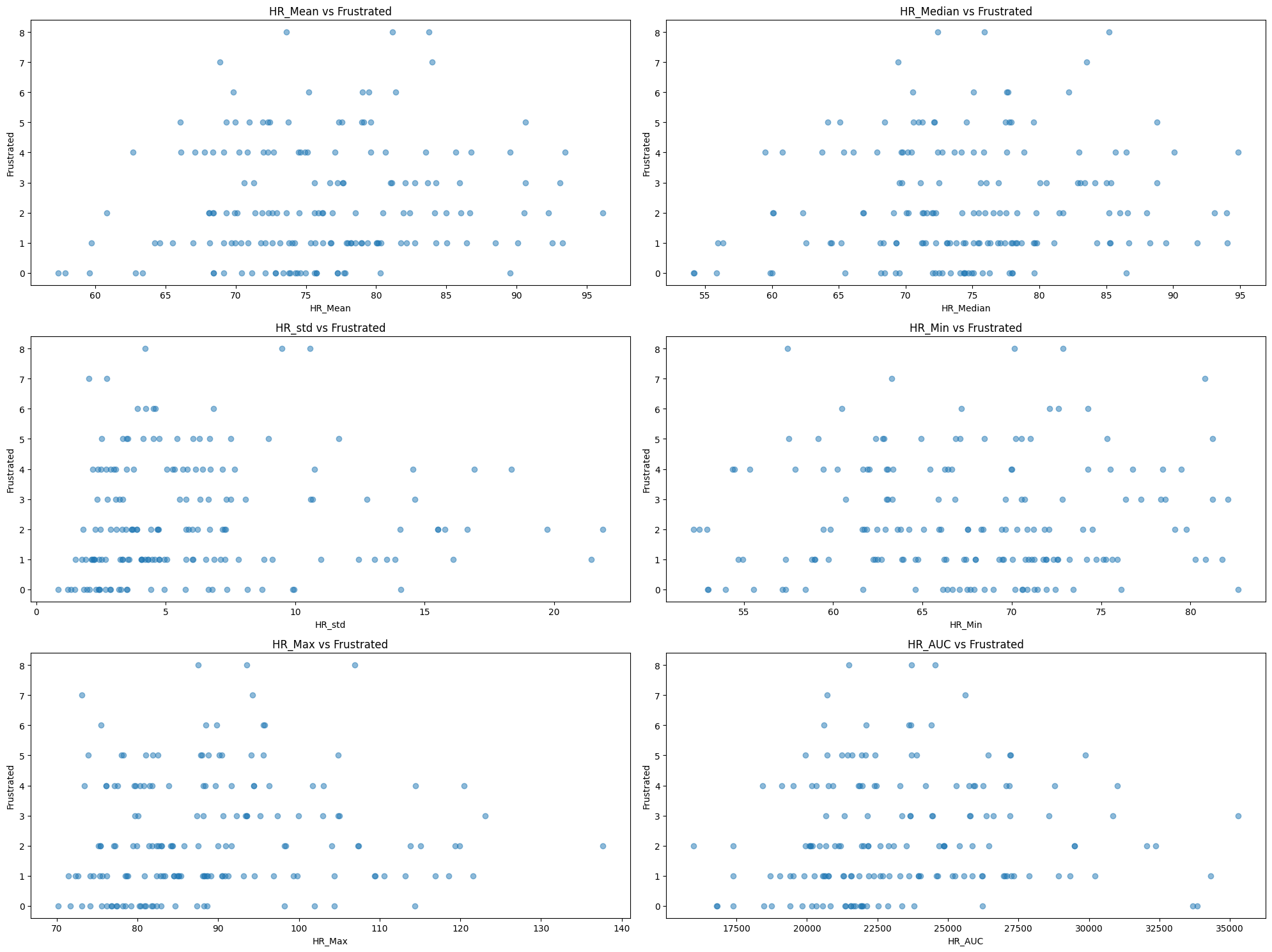
The scatterplots above already hint at the answer: no feature shows a visible relationship with frustration. The models bear it out.
- The Friedman test was significant (statistic 25.15, p = 0.00013), so the models do differ from each other, but none beat the baseline significantly. Mean errors: baseline 4.48, KNN 4.43, RF 4.82, ANN 7.13, logistic 6.55, ridge 20.19.
- Only KNN edged below the mean baseline (4.43 vs 4.48), and not significantly. Ridge regression was wildly the worst, an interesting failure: it extrapolated far outside the training range on one fold and blew up, while the other models stayed bounded by the actual frustration scale.
- The variability-aware Setup II comparisons were all insignificant, so I could not even confirm the ranking would hold on different training data.
Takeaway: heart-rate summary statistics carry little to no usable signal about self-reported frustration in this experimental setup. A useful reminder that a careful, group-aware evaluation is exactly what lets you report a clean negative result with confidence, rather than an inflated one from leaked structure.